Workbench Height Guide: What Height Should a Workbench Be?
The standard UK industrial workbench height is 840mm. That suits general workshop and assembly work for most adults. But the right height depends on the job: for precision work set the surface 50–100mm above elbow height, for general assembly at or just below elbow height, and for heavy work where you need to push down 100–250mm below elbow height.
This guide covers how to work out the right height for your operators, why the 840mm standard is set where it is, and when a height-adjustable bench is genuinely worth it — and when it isn't.
Recommended workbench height by task
All figures are relative to the operator's standing elbow height, measured with arms hanging and elbows bent to 90°.
| Type of work | Surface height | Why |
|---|---|---|
| Precision and fine detail — electronics assembly, inspection, soldering | 50–100mm above elbow height | Brings the work closer to the eye without hunching. Elbow support matters at this height. |
| Light assembly and general bench work | At elbow height, or slightly below | Neutral shoulder and wrist position for repetitive handling. |
| Heavy work — fabrication, engine work, anything needing downward force | 100–250mm below elbow height | Lets the operator get over the work and use body weight instead of shoulder strength. |
| Seated work | Surface set so elbows rest at 90° when seated, with clear knee space beneath | Bench height and seat height have to be specified together. |
How to measure it for your workshop
- Have the operator stand upright in their normal work footwear, arms hanging loose.
- Bend the elbows to 90°, forearms parallel to the floor.
- Measure from the floor to the underside of the elbow. That is elbow height.
- Apply the offset from the table above for the type of work.
- Remember to measure to the working surface — if you are fitting a mat, a jig or a fixture plate, that thickness comes off the bench height.
Where several people share one bench, set the height for the tallest regular operator and provide a platform or an anti-fatigue mat for shorter operators, rather than forcing the tallest to stoop. Stooping is where back complaints come from.
Why the standard is 840mm — and when it's wrong for you
840mm is the standard working height across our range, and it is the height most UK industrial benches are built to. It is not arbitrary. Standing elbow height for an adult is typically a little over a metre, so an 840mm surface sits roughly 150–250mm below the elbow for most people. That puts it squarely in the heavy work band in the table above.
That is the right call for a bench built for fabrication, vehicle work and general engineering, which is what most industrial benches are for.
It is the wrong call if your work is precision. An electronics technician doing fine assembly at 840mm will be leaning over the work all day. That operator wants a surface nearer 1,100mm, or an 840mm bench with the work raised on a fixture. It is worth checking before you order, because the fix afterwards is a new bench.
Our welding benches are built at 900mm rather than 840mm, for the same reason in reverse — the work sits on top of the bench surface, so the effective working height is higher than the bench itself.

Height adjustable or made to measure?
Height-adjustable benches — wind-up, crank or electric column — have a real place. They are worth the cost when:
- Several operators of noticeably different heights share the same bench across shifts
- The same operator alternates between seated precision work and standing assembly
- The work itself changes height through the process, such as building up an assembly
They are usually not worth it when one operator uses one bench for one kind of work. In that situation the mechanism gets set once on installation and never touched again — and you have paid for a moving part, lost some rigidity, and introduced something that can fail, to achieve a height a fixed bench would have held for good.
We build to order, so if 840mm is not your number we make the bench at the height you actually need. For most single-operator, single-task workstations that is a better answer than an adjustable mechanism: full rigidity, nothing to maintain, and the correct height from day one.
Bench height and load capacity are linked
Worth knowing when you specify: a bench built taller than standard has longer legs, and a bench built lower is inherently stiffer. Our range runs from 200kg to 2,500kg UDL (uniformly distributed load), and where a non-standard height affects the rating for the work you are doing, we will say so when we quote rather than after delivery.
Specifying a workbench height with us
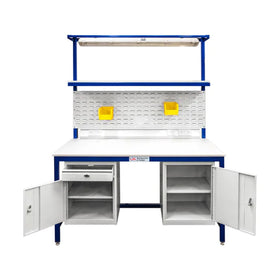
Every bench we make is manufactured in Britain, fully welded and delivered ready to use. Standard working height is 840mm; welding benches are 900mm. If you need a different height, tell us the figure or tell us the operator's elbow height and the type of work, and we will build to it.
Call 0161 688 6737 or request a quote. We accept purchase orders and issue proforma invoices, and volume pricing applies from five units.
Also see Steel Heavy Duty Workbench and Medium Duty Laminate Workbench if wood is not the right top for the job.
Need a bench at a specific height?
We manufacture to order in Britain. Tell us the working height you need — or just the operator's elbow height and the type of work — and we'll build to it. Purchase orders accepted, volume pricing from five units.
Frequently asked questions
What is the standard height of a workbench UK?
840mm is the standard working height for UK industrial workbenches, and the height our range is built to as standard. Welding benches are typically higher, at 900mm, because the workpiece sits on the surface.
What height should a workbench be for precision work?
50 to 100mm above the operator's standing elbow height, which for most adults puts the surface well above a standard 840mm industrial bench. Measure the individual operator rather than working from an average, and provide elbow support at this height.
What height should a workbench be for heavy work?
100 to 250mm below the operator's standing elbow height, so they can get over the work and apply downward force using body weight rather than shoulder strength. The standard 840mm height already sits in this band for most adults.
How do I measure the right workbench height?
Stand upright in work footwear with arms hanging, bend the elbows to 90° so the forearms are parallel to the floor, and measure floor to underside of elbow. Then add or subtract the offset for the type of work. Measure to the finished working surface, allowing for any mat, jig or fixture plate on top of the bench.
Are height adjustable workbenches worth it?
They are worth it where several operators of different heights share a bench, where one operator alternates between seated and standing work, or where the work changes height through the process. For a single operator doing one kind of work, a bench made to the correct fixed height is usually better — more rigid, nothing to maintain, and correct from the first day.
Can you make a workbench at a non-standard height?
Yes. We manufacture to order, so we build to whatever working height you specify. If you are not sure of the figure, give us the operator's elbow height and the type of work and we will work it out with you.
What height should a workbench be for seated work?
Set the surface so the operator's elbows rest at roughly 90° when seated at their normal chair height, and make sure there is clear knee space beneath the bench. Bench height and seat height have to be specified together — a bench sized for standing work will not suit a seated operator on a standard chair.
Leave a comment